A Greenhouse Ventilation System That Works
7 min read
A sunny 68-degree afternoon can push a small greenhouse past 100 degrees before you finish work. That is why a greenhouse ventilation system is not an optional upgrade for most backyard growers. It is the equipment that keeps lettuce from bolting, tomatoes from dropping blossoms, and damp leaves from becoming a disease problem.
The goal is not to make your greenhouse feel perfectly climate-controlled. It is to replace hot, humid indoor air with fresh outdoor air often enough that plants can keep functioning. A good setup should also be simple enough that it does not create another daily chore.
What a greenhouse ventilation system actually does
Ventilation manages three connected problems: excess heat, high humidity, and stagnant air. Sunlight warms the structure quickly, even when outdoor temperatures feel mild. Plants then release moisture through their leaves, and that moisture can condense on glazing, foliage, and soil surfaces overnight.
When warm, wet air has nowhere to go, trouble follows. Tomatoes and peppers may struggle to set fruit when temperatures stay too high. Seedlings become soft and stretched. Powdery mildew, botrytis, and leaf spot get the damp, still conditions they prefer.
Ventilation is different from air circulation, though both matter. An exhaust fan or open roof vent exchanges indoor air for outdoor air. A small circulating fan moves air around within the greenhouse, helping prevent damp pockets near dense foliage. One cannot fully replace the other.
For a simple seasonal greenhouse, opening the door and roof vents may be enough on many days. For a compact DIY greenhouse or one that sits in full afternoon sun, relying on memory is where plants get exposed. An automatic system earns its keep because heat spikes do not wait until your evening garden walk.
Start with the greenhouse, not the fan
Before choosing equipment, look at the structure you have. A tunnel greenhouse with roll-up sides behaves differently from a rigid polycarbonate house. A shaded site needs less cooling capacity than a greenhouse against a south-facing fence that reflects heat back onto it.
Measure the interior length, width, and average height. Multiply them to find the greenhouse volume in cubic feet. This gives you a sensible starting point for fan sizing. Many home greenhouse plans target enough exhaust capacity to exchange the full air volume about once per minute in warm weather. A 6-by-8-foot greenhouse with an average interior height of 7 feet holds roughly 336 cubic feet, so an exhaust fan rated around 350 CFM is a reasonable baseline.
That baseline is not a universal rule. Add capacity if your greenhouse gets hard afternoon sun, has a dark floor, is tightly enclosed, or holds mature tomatoes and cucumbers. You may need less in a shaded spring seed-starting house. Oversizing a fan slightly is usually safer than discovering too late that it cannot keep up, but a huge fan can chill seedlings during cold spells and wastes power.
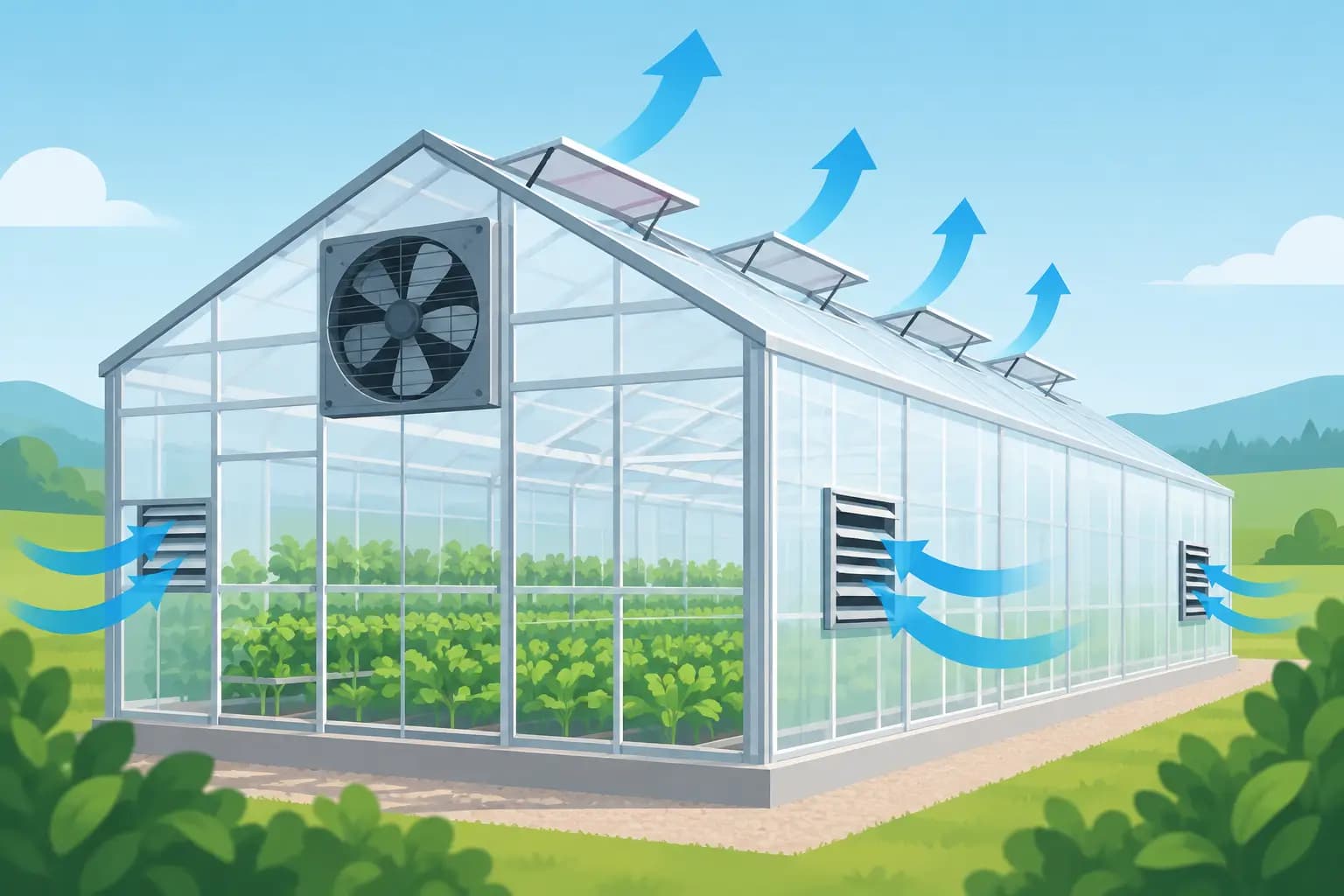
Just as important, every exhaust fan needs a route for replacement air. If a fan pulls air out but intake vents are tiny, blocked, or on the same wall, it works harder without cooling the whole space. Put intake vents low on one end or side of the greenhouse and the exhaust fan high on the opposite end. Hot air rises, so that layout encourages it to leave rather than linger above the crop canopy.
The parts worth prioritizing
A dependable greenhouse ventilation system does not need a complicated control panel. For most home growers, the useful core is an exhaust fan, intake ventilation, a thermostat, and one or two gentle circulation fans.
Exhaust fan and intake vents
Choose an exhaust fan intended for greenhouse, shed, or agricultural use, rather than a household fan placed near moisture. Look for a shuttered model if the wall opening is exposed to rain and wind. The shutters close when the fan is off, reducing drafts and limiting heat loss at night.
Intake area should be generous. Louvered vents, screened openings, a low door vent, or roll-up sidewalls can work. Screens keep out many insects and rodents, but very fine insect mesh restricts airflow. If you use it, increase the intake area and check it often for dust, pollen, and cottonwood fluff.
Thermostat and automatic vent openers
A thermostat turns the exhaust fan on at a set temperature, often somewhere around 80 to 85 degrees for warm-season crops. The right number depends on what you are growing. Lettuce and brassica seedlings need relief sooner than established peppers, while tender starts can be damaged if cold air runs across them on a chilly morning.
For roof vents, solar-powered wax-cylinder openers are a low-maintenance option. As the air warms, the wax expands and opens the vent without electricity. They are not perfect: they need seasonal adjustment, cannot respond to humidity, and may not open far enough in extreme heat. Still, they offer valuable protection when you are away.
Use a separate min-max thermometer or a basic temperature and humidity sensor, even with automation. Check the high and low readings for a week. The plants and the data will tell you whether the thermostat setting is actually working.
Circulation fans
Place circulation fans so they create a slow, broad movement of air across and above the plants. You should see leaves barely move, not bend hard in one direction. Pointing a strong fan directly at seedlings can dry them quickly and cause stress.
In a small greenhouse, one oscillating fan may be enough. In a fuller 8-by-12-foot structure, two small fans at opposite ends are often better than one powerful fan. As tomatoes, cucumbers, and herbs fill in, adjust the fan position so air can still move through the center of the canopy.
Set it up for the season you are in
Spring ventilation is a balancing act. Bright days can overheat a closed greenhouse, while nights may still drop near freezing. Let the thermostat handle daytime heat, but do not leave every vent open through a cold night just because it was warm at 3 p.m. Close manually operated openings before temperatures fall, and keep a close eye on forecasts.
Summer is about shedding heat early. Run ventilation before the greenhouse becomes painfully hot, not after. Shade cloth can reduce the workload on fans, especially on the west or south side. Watering paths or floors can cool briefly through evaporation, but it also raises humidity, so it is not a substitute for exchanging air.
In fall, reduce ventilation as outdoor temperatures drop, but do not seal the greenhouse completely. Dense plantings still create humidity, particularly after watering. A short midday air exchange can be enough to dry foliage and prevent condensation from lingering into the night.
Winter growing requires the most restraint. Ventilation is still needed on sunny days, but every fan cycle throws out expensive heat. Use a thermostat with a higher level of control if possible, run circulation fans gently, and water early enough that leaves and soil surfaces can dry before dark.
A 15-minute weekly check that prevents failures
Most ventilation problems are boring mechanical issues, not mysterious plant problems. Give the system a quick check during your weekly garden review. Confirm that the fan turns on at the thermostat setting, shutters open fully, and intake vents are not blocked by pots, tools, or trailing vines.
Clean screens and fan guards when debris builds up. Listen for rattling or a slow motor, and inspect cords for moisture damage. If you have automatic roof vent openers, make sure the brackets are tight and the vent moves freely. A stuck roof vent can turn a manageable warm day into a crop loss.
Watch for clues from the plants, too. Persistent condensation at dawn, mildew low in the canopy, and leaves that stay wet after watering suggest airflow is insufficient. Scorched leaf edges, curled new growth, or flowers dropping during hot weather suggest your greenhouse is overheating. These signals are more useful than a generic care sheet because they tell you what needs attention in this particular structure.
Tomatograph can help keep that check tied to your actual forecast and crop stage, so "inspect the greenhouse fan" appears before a warm spell instead of after your basil has already wilted.
When passive ventilation is enough
You may not need powered exhaust if your greenhouse has large roof vents, wide roll-up sides, reliable daily attention, and a mild growing season. Passive ventilation is quiet, costs nothing to run, and avoids electrical work. It is often excellent for a hoop house used mainly in spring and fall.
Its limitation is predictability. Still, humid weather and windless hot afternoons reduce its effectiveness. A small exhaust fan gives you more control in a rigid greenhouse, especially if you grow through summer or cannot open vents at the right moment every day.
Build the system around the weather pattern that gives your garden the most trouble. If late-day heat is the threat, automate the exhaust. If wet spring mornings bring disease, improve air exchange and circulation. A greenhouse should make growing food easier, and a few well-placed vents and fans can keep it that way.