How to Fertilize Lawn Grass Without Guesswork
7 min read
A lawn rarely needs more fertilizer because it looks pale on a Tuesday. It usually needs a better decision about timing, grass type, and what the weather will do next. Learning how to fertilize lawn grass means feeding it when it can actually use those nutrients, rather than scattering product before a heat wave, a downpour, or a dormant stretch.
For most home lawns, fertilizer is not a weekly chore or a rescue treatment. It is a few well-timed applications that support roots, density, and recovery from mowing, kids, pets, and summer stress. Get those applications right and your lawn asks for less attention between them.
Start With the Grass You Actually Have
The best fertilizing schedule depends on whether your lawn is cool-season or warm-season turf. This matters more than the calendar date on the fertilizer bag.
Cool-season grasses, including tall fescue, Kentucky bluegrass, perennial ryegrass, and fine fescue, grow most actively in fall and spring. They generally benefit most from fertilizer in early fall, with a lighter application in late fall if the grass is still green and growing. Spring feeding can help, but heavy spring nitrogen often creates fast top growth just before summer heat puts roots under pressure.
Warm-season grasses, including bermudagrass, zoysiagrass, St. Augustinegrass, centipedegrass, and bahiagrass, wake up later in spring and grow hardest during warm weather. Wait until the lawn has fully greened up and is actively growing before feeding it. Fertilizing too early pushes weeds and creates tender growth before the turf is ready.
If you do not know your grass type, look at how it behaves. A lawn that stays green through a mild winter but slows in summer heat is likely cool-season. A lawn that turns tan after frost and fills in during hot weather is likely warm-season. Grass type determines the season. Your local weather determines the exact week.
Test the Soil Before Adding More
Nitrogen gets most of the attention because it deepens green color and drives growth. But nitrogen is not the only nutrient a lawn may need, and more is not automatically better.
A basic soil test tells you pH, phosphorus, potassium, and often organic matter. It gives you a starting point that a bag label cannot. Many established lawns already have enough phosphorus, and applying more can contribute to runoff into streams and ponds. Some states and communities restrict phosphorus lawn fertilizers unless a soil test shows a need.
Use the soil test to choose a fertilizer, not just to confirm a product you already bought. If phosphorus and potassium are adequate, a nitrogen-focused lawn fertilizer may be the sensible choice. If soil pH is far outside your turf's preferred range, fertilizer alone will not solve the problem. Grass cannot efficiently use nutrients that are chemically tied up in unsuitable soil.
A soil test is especially useful when the same area stays thin, yellow, or weak despite regular care. Compaction, shade, poor drainage, grubs, and shallow irrigation can look like a fertilizer problem from across the yard.
Choose a Fertilizer and Rate That Fit the Job
The three numbers on a fertilizer bag show the percentage by weight of nitrogen, phosphorus, and potassium. A 24-0-6 product contains 24% nitrogen, no phosphorus, and 6% potassium. For lawn growth and color, nitrogen is usually the main number to manage.
Most established lawns should receive no more than about 1 pound of actual nitrogen per 1,000 square feet in a single application. Some lawns need less, especially centipedegrass, newly seeded turf, shaded areas, or lawns that are already dark green and vigorous. Check local extension guidance or restrictions for your grass and region.
To calculate how much product provides 1 pound of nitrogen, divide 100 by the first number on the bag. For a 24-0-6 fertilizer, 100 divided by 24 equals 4.2. That means you would apply about 4.2 pounds of product per 1,000 square feet to supply 1 pound of nitrogen.
If that calculation feels like the kind of task that gets postponed until the bag is empty, use the label's spreader setting as a starting point, but still measure your lawn. A 5,000-square-foot lawn and a 12,000-square-foot lawn should not receive the same amount because they happen to have the same size bag in the garage.
Slow-release nitrogen is usually the calmer choice for a home lawn. It feeds over time, reduces sudden flushes of growth, and lowers the chance of burning turf when applied correctly. Quick-release fertilizer can green grass fast, but it demands more precise timing and carries more risk in hot, dry, or stressed conditions.
How to Fertilize Lawn Grass Step by Step
Plan to fertilize when grass is dry, soil is not frozen or saturated, and a gentle watering is possible afterward. Avoid an application when heavy rain is expected within the next day or two. A downpour can move nutrients off the lawn before roots get the benefit.
First, measure the lawn area. Break an irregular lawn into simple rectangles, circles, or triangles, calculate each section, and subtract patios, driveways, sheds, and planting beds. You only need a close estimate, but guessing wildly is how lawns get overfed.
Next, fill the spreader on a driveway or tarp, not over grass. Sweep up any spills. Fertilizer left on hard surfaces can wash into storm drains, where it does not help your lawn or local waterways.
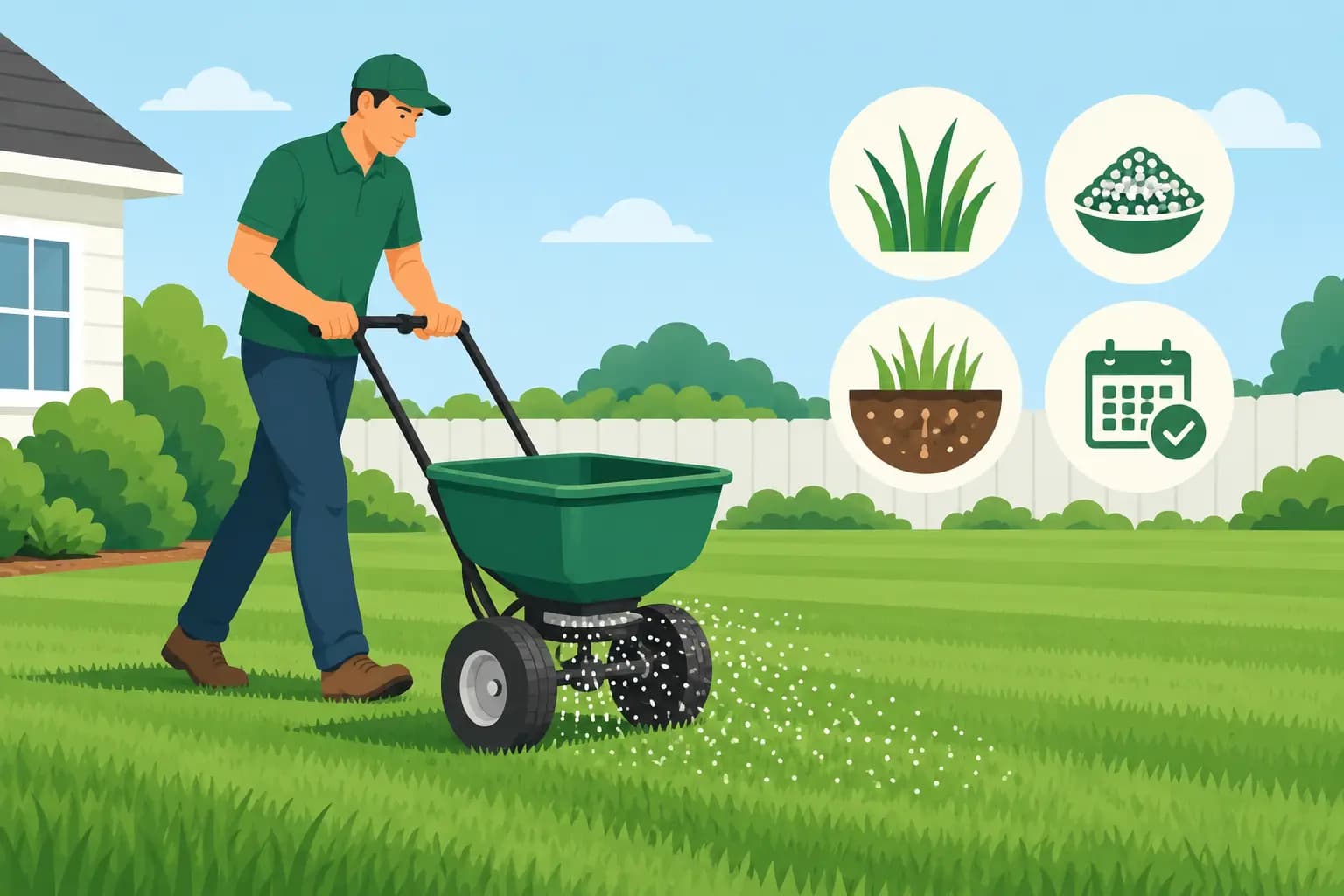
Set the spreader slightly below the bag's recommended rate for your product and make two passes at right angles if possible. Applying half the material north to south and the other half east to west creates more even coverage than trying to deliver the full amount in one pass. Overlap lightly, but do not double up at the edges where spreader patterns already overlap.
Afterward, water lightly enough to move granules off the blades and into the soil. Usually about a quarter inch is enough, unless the product label says otherwise. Do not soak the lawn simply because you fertilized it. Roots benefit from moisture in the soil, while excess water can carry nutrients away.
Time It Around Growth, Not Guilt
For cool-season lawns, the strongest feeding window is usually late summer through fall, when nights cool and root growth accelerates. A typical plan may include one application around early fall and another six to eight weeks later, adjusted for your climate and fertilizer choice. If you fertilize in spring, keep it moderate and avoid pushing lush growth as summer approaches.
For warm-season lawns, begin after full green-up in spring, then feed during the active growing season if the lawn needs it. Stop early enough in fall that you are not encouraging soft new growth just before the first frost. Exact dates vary sharply between Florida, Texas, North Carolina, and the Midwest, so watch the lawn's growth stage rather than copying a schedule from another region.
Do not fertilize drought-stressed grass just to improve its color. If footprints remain visible, blades are folded, or the lawn has a gray-blue cast, address water stress first. Fertilizer does not replace water, and feeding a struggling lawn can add stress instead of relief.
Mow and Water in Ways That Support the Fertilizer
Fertilizer works best as part of a steady maintenance rhythm. Mow at the recommended height for your grass type, using a sharp blade. Taller mowing heights generally support deeper roots and shade the soil, which helps turf handle dry spells. Removing more than one-third of the grass blade at one mowing weakens the plant and can make it seem like it needs another dose of fertilizer.
Leave short, dry grass clippings on the lawn when practical. They return a modest amount of nitrogen and organic material to the soil. Clippings do not cause thatch by themselves, though thick mats from overgrown grass can smother patches and should be collected.
Water deeply and less often once the lawn is established, rather than giving it a daily sprinkle. Frequent shallow watering encourages shallow roots. Your soil type matters here: sandy soil may need smaller, more frequent watering than clay soil, which absorbs water slowly and can shed runoff if watered too fast.
Watch for the Signs That Say Stop
A dark green lawn that needs mowing every few days is not necessarily thriving. It may be receiving too much nitrogen. Excess fertilizer can create weak, disease-prone growth, increase thatch, invite pest issues, and raise your mowing workload.
If fertilizer stripes appear, do not immediately add more across the entire lawn. Check the spreader calibration, walking pace, and overlap pattern first. If you see brown, scorched-looking grass soon after feeding, water the area promptly and avoid additional products until the turf recovers.
The goal is not a lawn that grows as fast as possible. It is a lawn with enough density and root strength to handle ordinary life without becoming another urgent weekend project.
Before the next weather shift, take fifteen quiet minutes to check your grass type, measure the area, and look at the forecast. A well-timed, correctly measured application is one of those small jobs that makes the rest of the season easier.